
Micro-optical lens arrays
In-house development and manufacturing of COB lenses and lens arrays
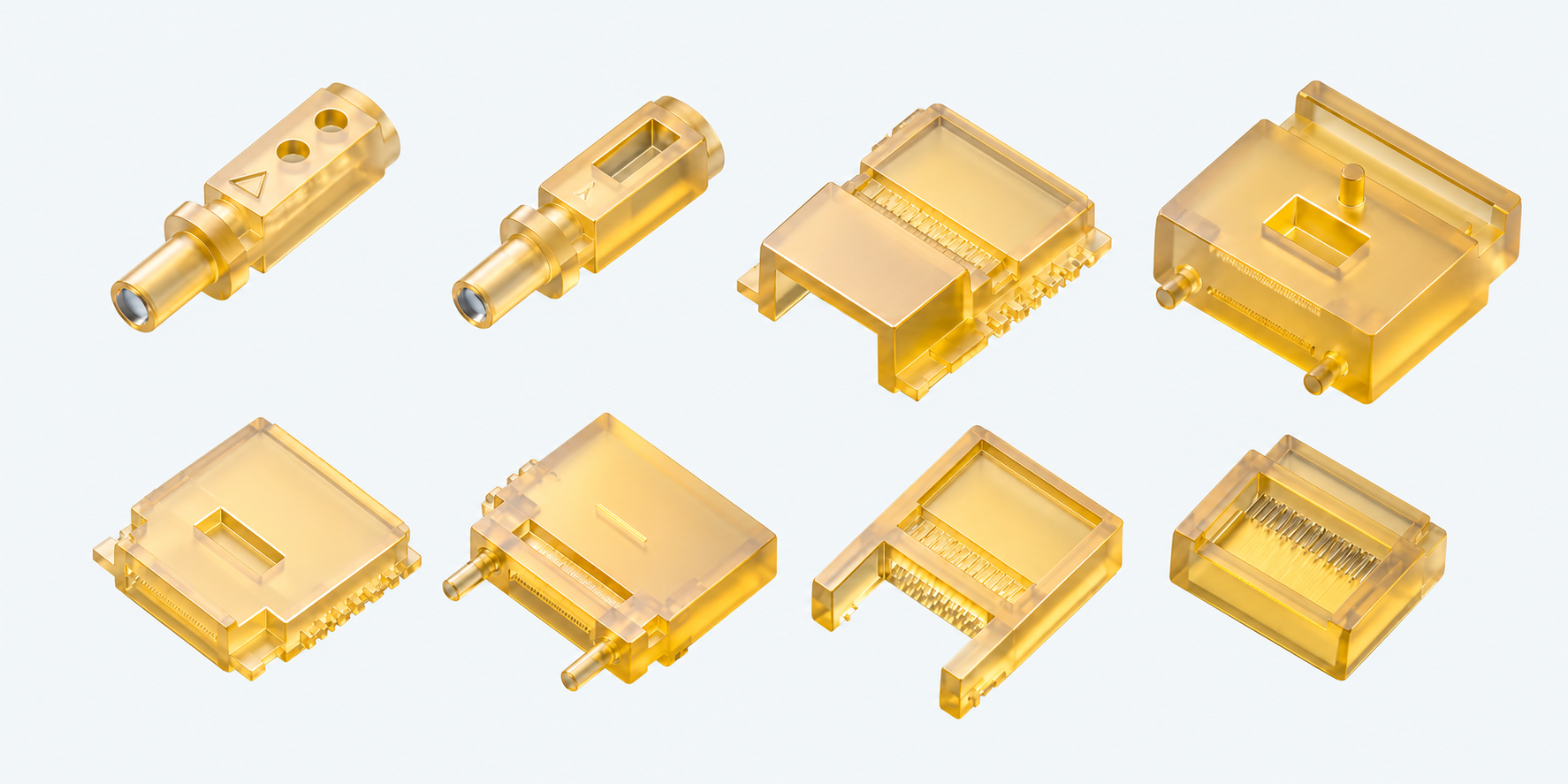
Micro-optical lens arrays · Product family rendering
Different structures. A shared focus on coupling.
Lumeterna develops and manufactures micro-optical lens arrays, including COB lenses, arrays for different data rates and other optical configurations. We provide lens products and development support tailored to the packaging space, mechanical design and optical coupling requirements of optical modules.
Explore the product family.
From 25G COB lenses to 100G, 200G and 400G arrays, a range of structures supports product selection and integration during development.
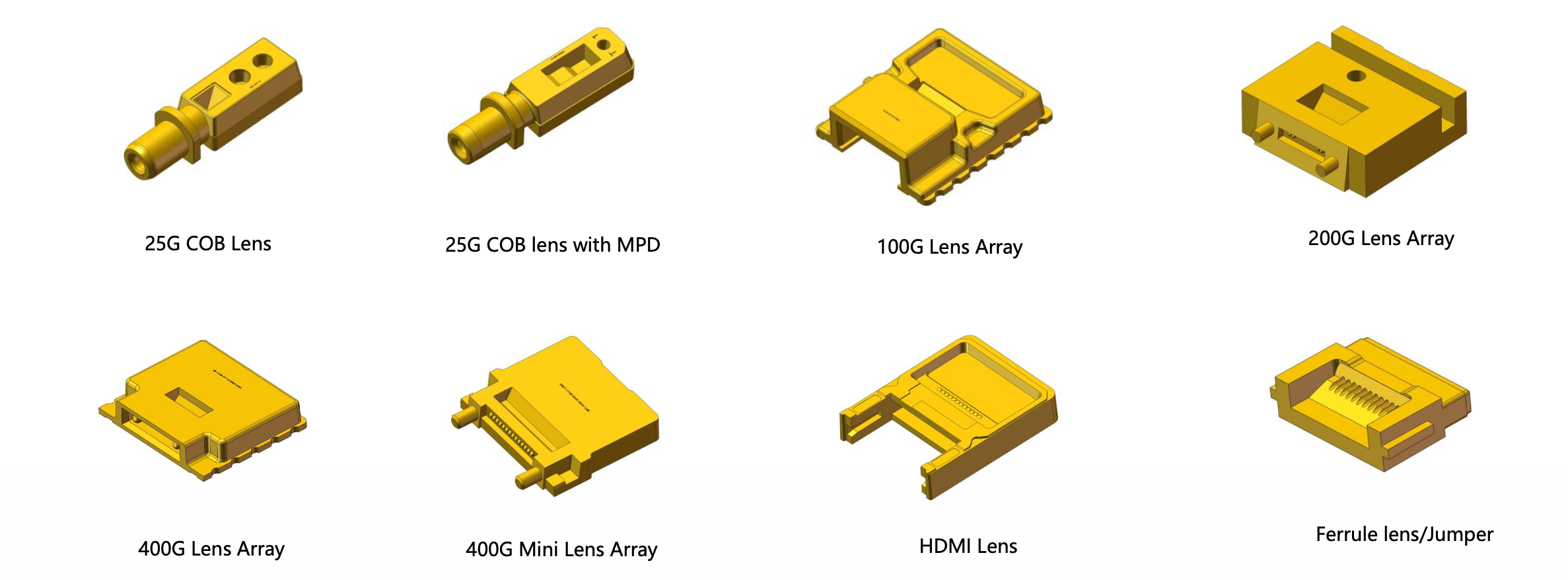
25G COB lens
25G COB lens with MPD
100G lens array
200G lens array
400G lens array
400G Mini lens array
HDMI Lens
Ferrule lens / jumper
25G—800G
Optical module application range
Developed for different data rates.
Lens selection, mechanical integration and development support are guided by the structural and optical coupling requirements of each optical module.
The lens configuration and integration approach are confirmed against the module design requirements for each project.
Products and development capabilities
Product families, application coverage and the information needed to begin development.
The illustrations also show a 200G lens array, a 25G COB lens with MPD, a 400G Mini array, an HDMI lens and a ferrule lens/jumper. Specific structures, dimensions and optical parameters are confirmed for each project. The application range does not mean that every illustrated product supports every data rate.
Frequently asked questions
What are COB micro-optical lenses, and what do they do in optical modules?
COB micro-optical lenses are precision optical components for compact optoelectronic packaging. They shape light and couple it efficiently between optical chips and fibers. By optimizing collimation, focusing and the optical path, COB lenses enable precise optical connections in limited space. Applications include high-speed optical modules, multi-channel optical communications and board-level optical interconnects.
How do COB lenses couple light between fibers and devices such as VCSELs and PIN/APD detectors?
At the transmitter, a COB lens collimates and focuses light from a source such as a VCSEL into the fiber. At the receiver, it focuses light emerging from the fiber onto the active area of a PIN or APD photodetector. Optimizing lens curvature, the optical path and alignment accuracy helps reduce coupling loss and improve optical transmission efficiency.
Which specifications matter when selecting a COB optical lens?
Key considerations include coupling efficiency, insertion loss, spot size, operating wavelength, alignment tolerance and consistency across channels. Selection should also account for the VCSEL or photodetector structure, fiber type and available packaging space. Optical design affects not only transmission efficiency, but also assembly complexity, manufacturing yield and long-term operating stability.
Start with your optical module design.
Share your target data rate, mechanical design and optical coupling requirements so we can identify a suitable lens solution.